
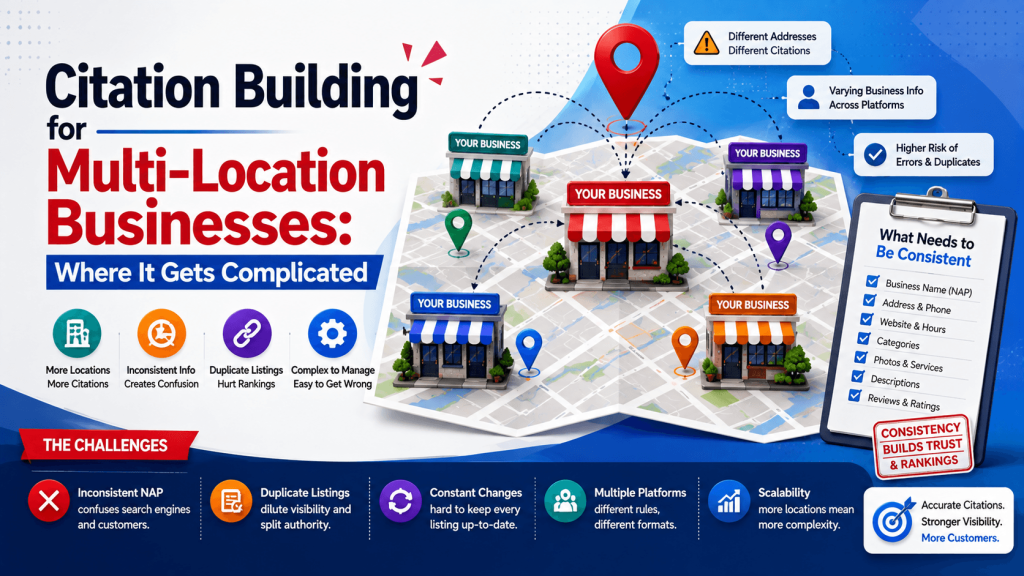
Managing one location’s online presence is manageable with a bit of attention. Managing five, or fifteen, introduces a different level of complexity entirely, where a small inconsistency at one location can multiply across an entire brand before anyone notices. I’ve seen franchise owners discover, years in, that half their locations had outdated phone numbers listed somewhere online.
Multi-location citation building requires more structure than a single-location approach, but the underlying principles remain the same: accuracy and consistency, applied at scale.
Why Multi-Location Businesses Face Unique Challenges
Each location typically needs its own accurate listing, its own Google Business Profile, and its own set of citations, rather than one generic listing representing the entire brand. This multiplies the potential points of failure. A change to a shared phone system or a rebrand can create inconsistencies across dozens of listings simultaneously if there isn’t a clear process for updating them.
Franchise businesses face an additional layer, since individual location owners sometimes manage their own listings independently, which can lead to formatting or accuracy drift between locations over time.
Building a Repeatable Process
The businesses that manage this well tend to create a master reference document listing the exact, approved format for every location’s name, address, phone number, hours, and category. Anyone updating a listing, whether it’s an owner, manager, or marketing team member, works from that single source of truth rather than improvising.
This same reference document makes it much faster to audit consistency across locations periodically, since you’re comparing against a known standard rather than guessing what’s correct.
Using Directories to Reinforce Consistency at Scale
Listing each location individually and accurately on a directory such as Rate Over gives a multi-location business another consistent, verifiable reference point per location, which supports the broader pattern of accuracy that search engines and AI tools look for when trying to confirm a business’s details.
This becomes especially valuable for newer locations still building their own independent history and reviews, since accurate citations help establish credibility for a location before it has years of standalone reputation behind it.
Conclusion
Citation building for multi-location businesses rewards structure and discipline more than any single clever tactic. A shared reference standard, applied consistently across every location’s listings, prevents the kind of quiet inconsistency that otherwise builds up unnoticed for years.